The 167-Hour Problem in Physical Therapy

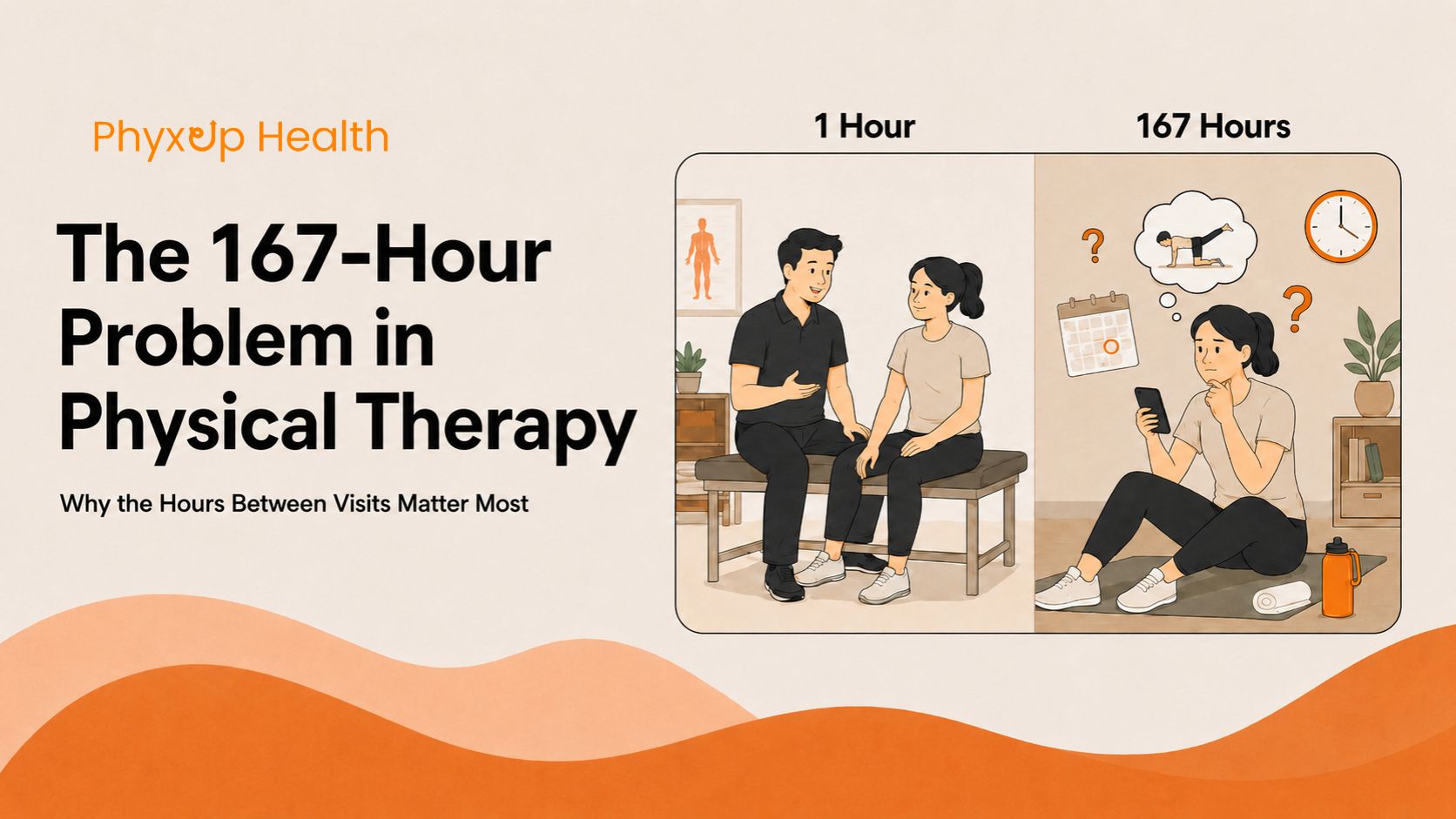
Your patient comes into the clinic once a week.
The visit lasts an hour.
During that time, your therapist can assess symptoms, guide exercises, adjust the plan of care, and answer questions.
But then the patient leaves.
For the rest of the week, your clinic is mostly working on hope.
- Hope they can do the home exercise program.
- Hope they understand the instructions.
- Hope they do not push too hard and hurt themselves.
- Hope their pain does not spike.
- Hope they remember what the therapist told them.
This is the 167-hour problem in physical therapy.
If a patient spends one hour per week in your clinic, there are still 167 hours left in that same week. Those 167 hours are where most of the recovery actually happens. They are also where most of the confusion, inconsistency, setbacks, and disengagement happen.
For outpatient physical therapy clinics, this is one of the biggest blind spots in care.
The clinic visit matters. It always will, and that will never change. But the appointment is only a small fraction of the patient’s recovery environment. The rest happens away from the clinic: at work, in the car, at the gym, on the stairs, while sleeping, while watching TV, and throughout daily routines.
The future of physical therapy will not be defined only by what happens during the appointment. It will be shaped by how well clinics support patients between appointments.
The Problem Is Not the Therapist
When patients do not follow their home exercise program, it is easy to assume the issue is motivation.
Sometimes that is true. But often, the story is more complicated.
A patient may skip exercises because they are afraid of making the pain worse. They may not remember the exact movement. They may be overwhelmed by the number of exercises assigned. They may feel better and assume they no longer need to continue. They may feel worse and assume physical therapy is not working.
None of these problems mean the therapist failed.
They mean the therapist is trying to influence a recovery process that mostly happens outside the clinic.
This is the difficult part of outpatient PT. A therapist can deliver excellent care during the visit and still have limited visibility into the patient’s week. By the time the patient returns, the therapist is often working from self-report and a quick conversation at the start of the session.
“How did the exercises go?”
“Pretty good.”
“Any pain?”
“A little.”
“Were you able to do them every day?”
“Mostly.”
That exchange may be honest, but it does not show the full picture.
Patients forget details. They compress several days of experience into a few sentences. They may underreport missed exercises because they feel embarrassed. They may overreport activity because they want to seem compliant. They may not know which details matter clinically.
The therapist is then forced to make decisions with limited information.
That is the 167-hour problem.
Patient Disengagement Is Quiet. It Builds Slowly.
Patients usually do not drop off all at once.
- One missed exercise becomes three.
- One unanswered question becomes uncertainty.
- One painful movement becomes fear.
- One canceled visit becomes a patient who never reschedules.
For clinic owners, this matters clinically and financially. The 167-hour problem affects outcomes, satisfaction, retention, referrals, and revenue.
When patients feel supported outside the clinic, they are more likely to stay engaged in their plan of care. When they feel disconnected, they are more likely to drift.
Home Exercise Programs Are Necessary, But Not Enough
Home exercise programs are essential.
But giving a patient exercises is not the same as knowing whether they are doing them, how they are responding, or whether the plan still fits their daily life.
- A patient may be doing the wrong movement.
- They may be doing too much.
- They may be doing too little.
- They may stop after two days.
- They may feel pain and not know whether to continue.
This is where Remote Therapeutic Monitoring, or RTM, becomes valuable.
RTM helps physical therapy clinics stay connected to patients between visits. It gives therapists a better view of home exercise adherence, symptoms, patient-reported progress, and therapy response outside the clinic.
It does not replace the therapist. It gives the therapist better information for higher-quality care.
 Sangwon Lim
RTM Helps Clinics See the Other 167 Hours
With Remote Therapeutic Monitoring, the clinic does not have to wait until the next appointment to learn that a patient struggled all week.
If a patient stops completing exercises, the clinic can see it sooner.
If pain increases, the therapist can respond earlier.
If the patient is confused, the clinic can provide support.
If the patient is progressing well, the therapist can reinforce confidence.
That visibility changes the quality of care.
Instead of asking:
“How did everything go?”
The therapist can ask a more specific question:
“I saw that your knee pain increased after your step-down exercises. What did that feel like?”
That type of conversation is more useful for both the patient and the therapist.
It makes patients feel valued and seen. It also helps therapists make better decisions during the visit. The appointment becomes more useful because the therapist already understands what happened between visits.
Why the 167-Hour Problem Matters for Clinic Owners
Most clinics are already busy.
Schedules are full. Margins are tight. Staff are stretched. Patients expect more communication and support than they did ten years ago. At the same time, clinics are being asked to improve outcomes, increase retention, and deliver a better patient experience.
The traditional model makes that difficult because so much of the patient journey happens outside the clinic.
RTM gives clinics a way to extend care without simply adding more appointments. It helps clinics support patients during the hours when they are most likely to struggle, lose motivation, or fall off track.
It also creates a more modern care experience, where patients feel connected to the clinic even when they are not physically there.
For outpatient PT clinic owners, this is not only a clinical opportunity. It is also an operational one. Better between-visit engagement can support stronger patient retention, more informed visits, improved satisfaction, and a more consistent care experience.
The 167-Hour Problem Is Not Going Away
Patients will always spend more time outside the clinic than inside it.
The question is whether your clinic has a way to stay connected during that time.
Remote Therapeutic Monitoring helps outpatient physical therapy clinics make the invisible part of recovery easier to see, support, and act on.
The appointment still matters. But the hours between appointments may matter even more.
Ready to see how PhyxUp Health can help your clinic support patients during the other 167 hours? Request a demo