5 Reasons RTM Claims Get Denied (And How to Prevent Them in 2026)
Most RTM claim denials trace back to five preventable billing errors. Here is how small PT clinics fix each one and stay current with the 2026 CMS code changes.

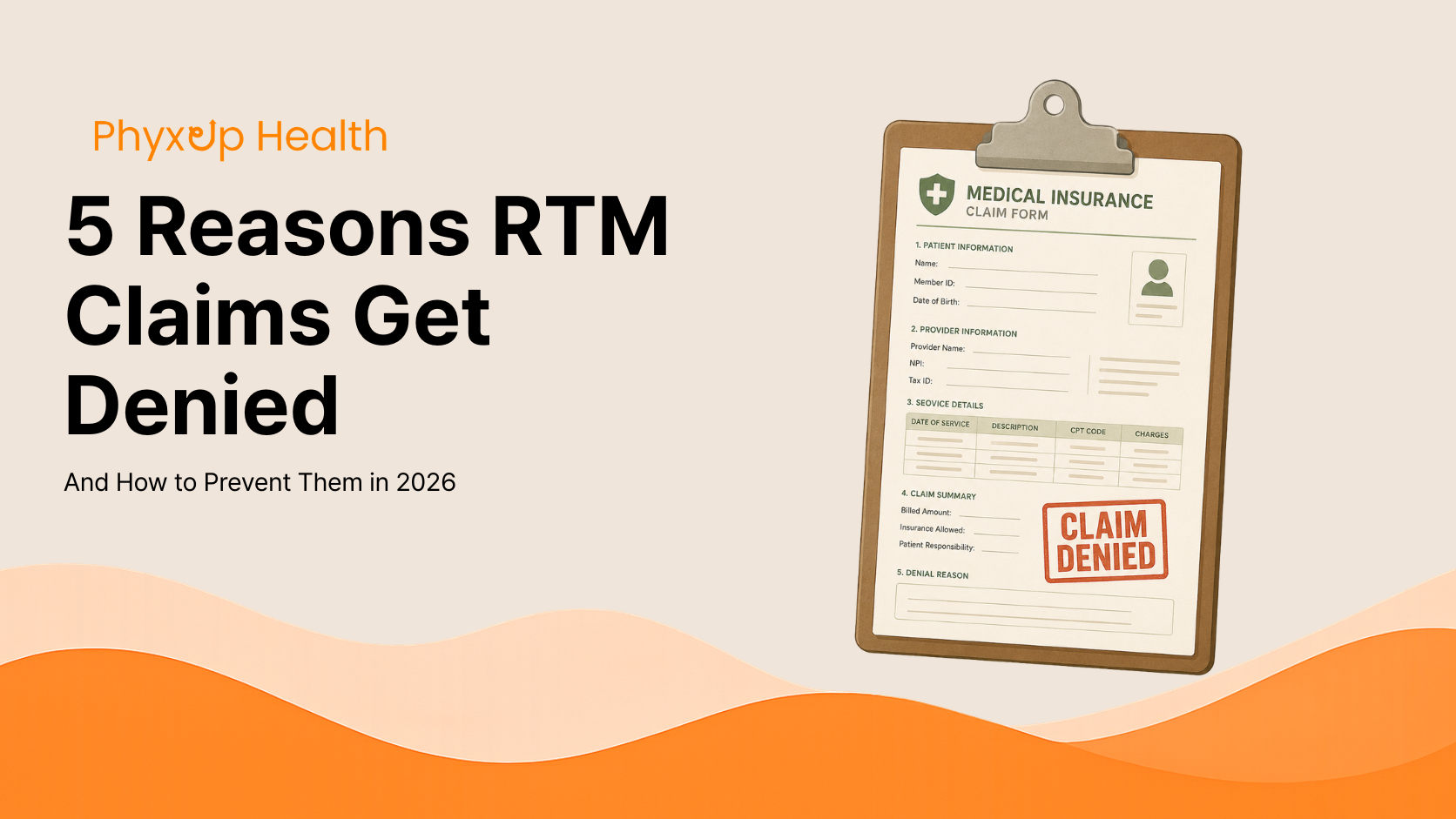
RTM claims are commonly denied for five preventable reasons: mismatched device-supply codes, undocumented patient consent, incomplete time logs, duplicate billing of mutually exclusive codes, and outdated 2025 code logic. Since CMS's CY 2026 Physician Fee Schedule final rule took effect on January 1, 2026, two new codes have changed the rules clinics need to follow.
Reason 1: Data Transmission Days Don't Match the Billed Code
CPT 98977 requires 16–30 days of monitored data within 30 days. The most common denial happens when a clinic bills 98977 with only 10–12 days of data. Under the CMS CY 2026 final rule, a new code, 98985, covers 2–15 days of MSK data transmission in 30 days, so a low-engagement patient no longer has to go unbilled or get denied under 98977. For non-MSK programs, CMS created parallel 2–15 day codes: 98984 for respiratory and 98986 for cognitive behavioral therapy.
Prevention checkpoint: Before billing, confirm actual transmission days against the code's threshold. Route patients with 2–15 days to 98985, and 16–30 days to 98977.
Reason 2: Missing or Backdated Patient Consent
Medicare requires documented patient consent, verbal or written, before RTM monitoring begins, and some commercial payers may require written consent specifically. A frequent error is dating the consent form at month-end, when billing is processed, instead of the actual enrollment date.
Prevention checkpoint: Document consent at enrollment, store it in the patient record, and confirm the date precedes the first billable interaction, not the billing date.
Reason 3: Treatment Management Time Isn't Documented Minute-by-Minute
For 98979, 98980, and 98981, every minute of clinical time needs a timestamped start and end, the activity performed, and who performed it. Self-attestation, such as "I spent about 20 minutes," does not satisfy CMS documentation standards.
Prevention checkpoint: Use a platform that auto-generates timestamped logs rather than relying on staff to recall and record time after the fact.
Reason 4: Billing Mutually Exclusive Codes Together
Device-supply codes are mutually exclusive: bill either 98985 (2–15 days) or 98977 (16–30 days) for the same patient in the same 30-day period, never both. The same applies to treatment management codes: 98979 (new, first 10 minutes, billed for 10–19 minutes of treatment management) and 98980 (20 minutes) cannot both be billed in the same calendar month for the same patient.
Prevention checkpoint: Build a billing checklist that flags duplicate code pairs before claim submission.
Reason 5: Still Applying Pre-2026 Code Logic
CMS's CY 2026 Medicare Physician Fee Schedule final rule, issued October 31, 2025 and effective January 1, 2026, introduced 98985 and 98979 to cover shorter monitoring and communication windows. Clinics still billing under 2025 thresholds mismatch codes to actual monitored data and trigger denials.
Prevention checkpoint: Confirm your billing software or biller has updated to 2026 code logic. This is worth verifying directly with your RTM platform vendor.
Quick Reference
| Denial Cause | Threshold Rule | Fix |
|---|---|---|
| Wrong device-supply code | 98985: 2–15 days · 98977: 16–30 days | Match code to actual days |
| Missing consent | Documented (verbal or written), dated at enrollment | Document before first billable service |
| Incomplete time log | Timestamped start/end required | Automate logging, don't self-attest |
| Duplicate code billing | 98985/98977 and 98979/98980 are mutually exclusive | Add a pre-submission checklist |
| Outdated code logic | 2026 final rule effective Jan 1, 2026 | Confirm vendor/biller uses 2026 codes |
 Sangwon Lim
FAQ
What's the most common reason RTM claims get denied?
Billing CPT 98977 when the patient generated only 10–12 days of monitored data instead of the required 16–30 days.
Are 98985 and 98979 finalized or still proposed?
Finalized. CMS finalized both codes in the CY 2026 Medicare Physician Fee Schedule final rule, issued October 31, 2025, and effective January 1, 2026.
Can I bill both 98977 and 98985 for the same patient in the same period?
No. They are mutually exclusive device-supply codes for the same 30-day period. Use 98985 for 2–15 days of data and 98977 for 16–30 days.
Can I bill both 98979 and 98980 in the same month?
No. They are mutually exclusive treatment-management base codes. Bill 98979 for 10–19 minutes of treatment management or 98980 for 20 minutes or more, but not both in the same calendar month for the same patient.
What patient consent does Medicare require for RTM?
Documented consent is obtained verbally or in writing before monitoring begins and recorded in the patient's chart. Some commercial payers may require written consent specifically, so confirm each payer's policy.
Preventing Denials Without Adding Admin Work
Several of these denial causes stem from the same two problems: manual documentation and outdated code logic. Both are fixable with the right system. PhyxUp Health is built for small outpatient PT clinics that need RTM to run without having to pull a therapist off the floor to manage it. The platform captures timestamped treatment-management logs automatically, flags the correct 2026 device-supply code based on actual transmission days, and handles billing and claim submission end to end.
If claim denials have been cutting into your RTM revenue, see how PhyxUp Health handles the billing side.
Sources
- CMS, Therapy Code List: 2026 Annual Update (MM14250). https://www.cms.gov/files/document/mm14250-therapy-code-list-2026-annual-update.pdf
- CMS, CY 2026 Medicare Physician Fee Schedule Final Rule (Federal Register, Nov. 5, 2025). https://www.federalregister.gov/documents/2025/11/05/2025-19787/medicare-and-medicaid-programs-cy-2026-payment-policies-under-the-physician-fee-schedule-and-other
- APTA, Practice Advisory: Remote Therapeutic Monitoring Codes Under Medicare (2026). https://www.apta.org/your-practice/payment/medicare-payment/rtm-codes-practice-advisory