Remote Therapeutic Monitoring (RTM) 101: A Beginner’s Guide
Everything a small PT clinic needs to bill Remote Therapeutic Monitoring correctly: the five CPT codes, what they pay, and a step-by-step way to start.


What Is Remote Therapeutic Monitoring (RTM)?
Remote Therapeutic Monitoring is a technology-driven approach that lets healthcare providers track patient progress between in-person visits. Through a web or mobile app, the platform collects non-physiological data such as pain levels, exercise completion, and adherence to a home exercise program (HEP). That data gives providers an ongoing view of a patient's status instead of a single snapshot every few weeks.
RTM extends care beyond the clinic and keeps patients engaged with their recovery. Clinics running RTM on a fully managed platform like PhyxUp Health report 94% patient satisfaction and 80% patient engagement, well above the passive follow-up most clinics rely on today.
How Does RTM Work?
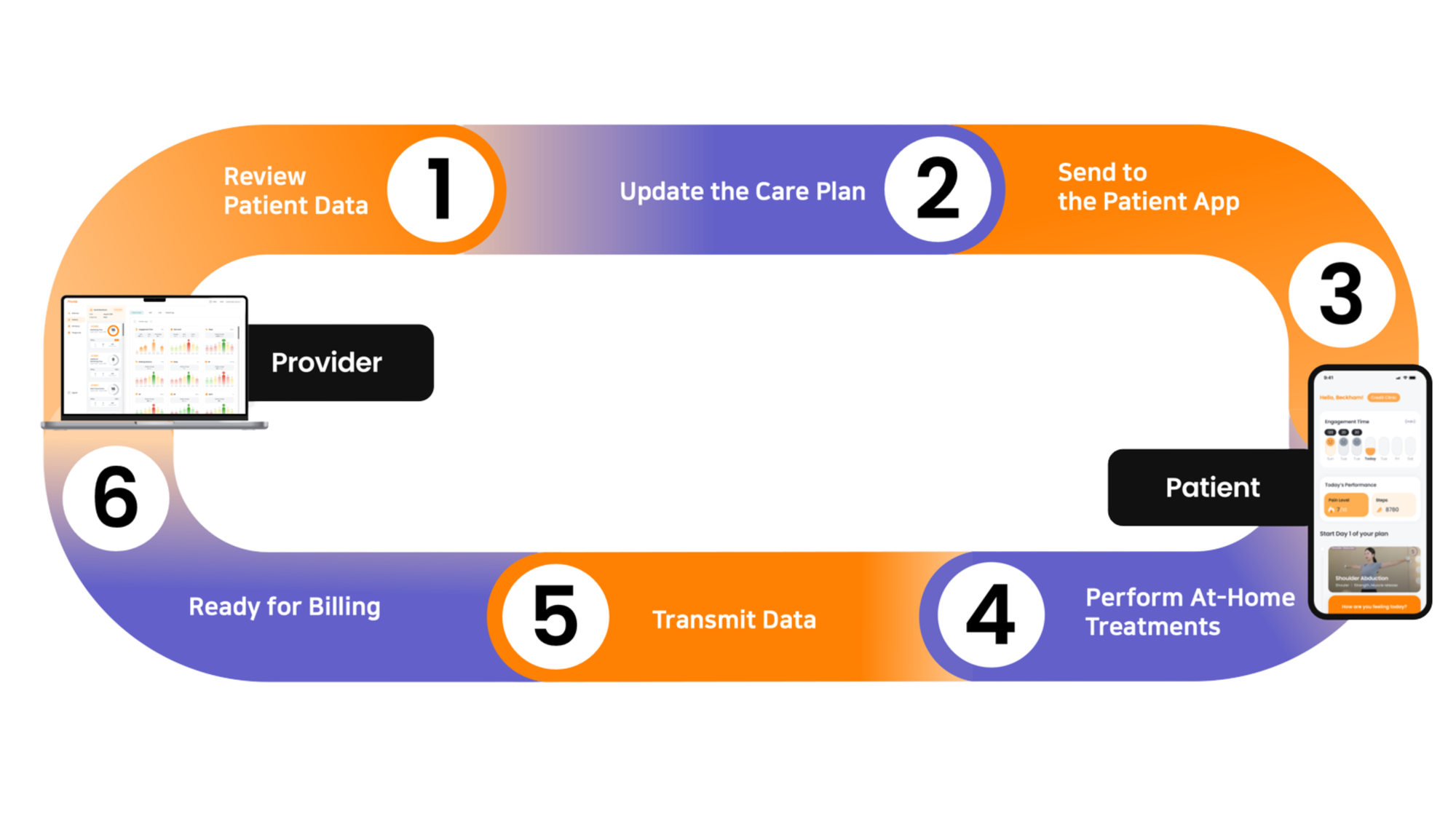
RTM follows a consistent cycle from the first visit through the monthly billing cycle.
Step 1. In-Person Session. The patient attends a PT session. The therapist sets recovery goals and a treatment plan.
Step 2. Home Exercise Program via App. The therapist sends a personalized HEP through an RTM app. The patient logs pain levels and completes exercises from home.
Step 3. RTM Collects Data. The app transmits exercise completion and pain data to the therapist's RTM dashboard, usually daily.
Step 4. Data Review by Therapist. The therapist reviews adherence and pain trends and flags any patient falling behind or reporting worsening pain.
Step 5. Clinical Decision Support. The therapist adjusts the plan when a patient reports ongoing pain despite completing the prescribed exercises.
Step 6. Plan of Care Updates. The plan evolves with the patient's actual progress, not just the plan made at the last in-person visit.
Step 7. Insurance Billing. Once the monitoring period closes, the clinic submits RTM claims for reimbursement.
RTM CPT Codes and Reimbursement
CMS defined five CPT codes to govern how RTM is billed. For a full breakdown of each code, see our complete CPT code guide.
 Sangwon Lim
| CPT Code | Service | Billing Frequency |
|---|---|---|
| 98975 | Initial setup and patient education | Once per episode of care |
| 98976 / 98977 | Device supply for RTM | Every 30 days |
| 98980 | First 20 minutes of treatment management | Monthly |
| 98981 | Additional 20 minutes of treatment management | Monthly, as needed |
Reimbursement varies by payer and region. Clinics on a fully managed RTM platform average $165 per enrolled patient per month, above the roughly $135 CMS national average, largely because consistent documentation and full CPT code capture close the gap that many clinics leave on the table.
Benefits of RTM for Clinics and Patients
- Creates a new monthly revenue stream through Medicare and commercial billing, without adding new patient volume
- Extends visibility between visits, which drives 80% patient engagement on a fully managed platform
- Cuts documentation time by 60% when monitoring and billing are handled outside existing staff hours
- Surfaces early warning signs, such as a patient reporting rising pain, before the next scheduled visit
- Supports 94% patient satisfaction by keeping patients engaged instead of leaving them to self-manage a HEP with no feedback loop
Getting Started with RTM
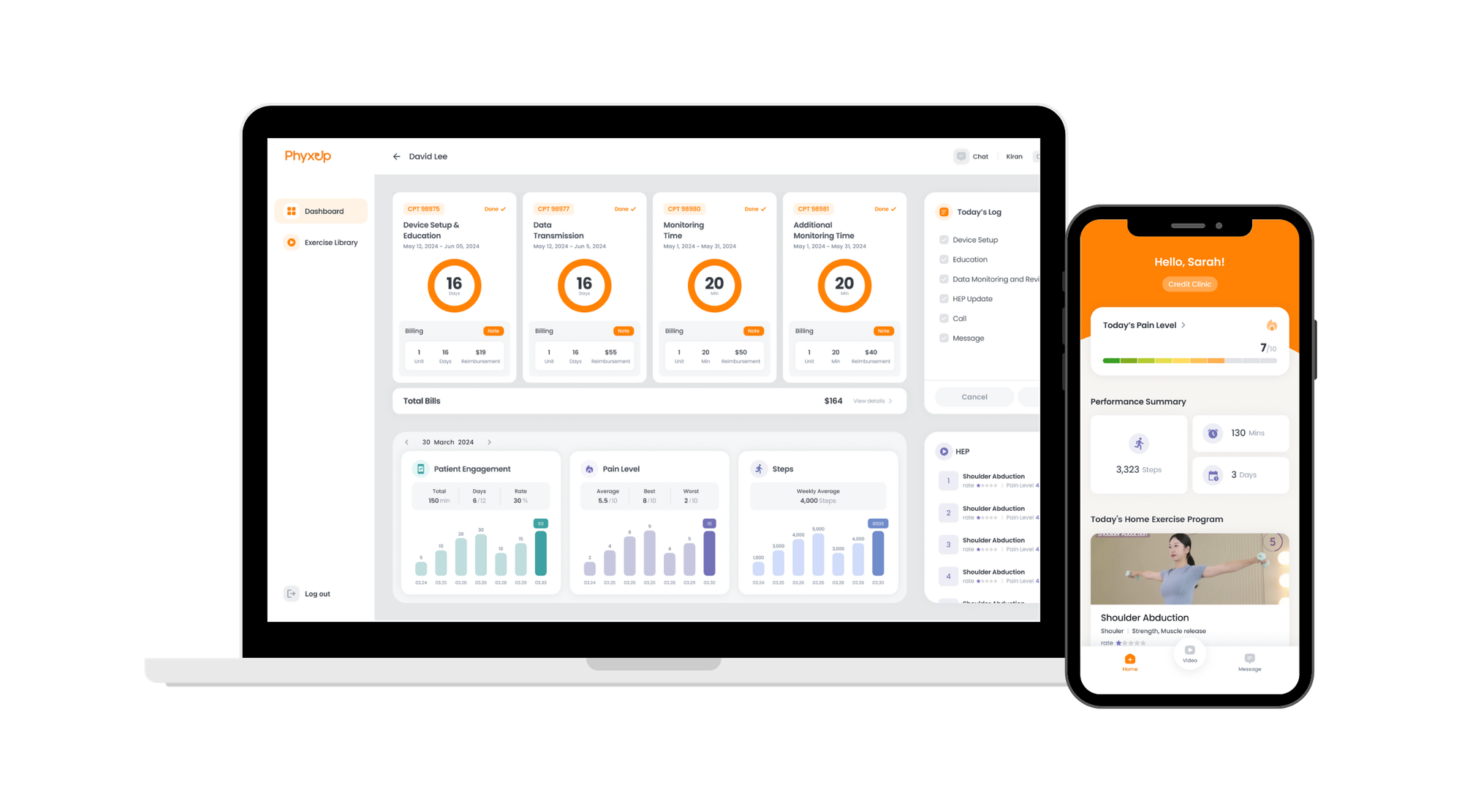
- Choose RTM software that meets the FDA's Software as a Medical Device (SaMD) framework. Not every app on the market qualifies for CPT 98976/98977 billing.
- Confirm patient eligibility and get consent for remote monitoring, the same way you would for any billed service.
- Bill CPT 98975 for the initial setup and patient education session.
- Enroll the patient in the app and monitor adherence and pain data throughout the month.
- Bill the monthly monitoring codes (98980, 98981) once the required minutes and days of data are documented.
Clinics that manage this process in-house often underbill, since tracking 16 days of data per code per patient is easy to lose across a full caseload. That's the gap a fully managed RTM service like PhyxUp Health is built to close.
Common Challenges and How to Solve Them
| Challenge | Solution |
|---|---|
| Patients stop logging data after the first week | Automated reminders and a simple, low-friction app reduce drop-off |
| Staff don't have time to review daily data | A fully managed RTM service handles monitoring and flags only what needs clinical attention |
| Claims get denied for incomplete documentation | Standardized documentation prevents the most common denial reasons (see the top 5 causes) |
| Clinic is unsure which devices qualify | Confirm the platform meets the FDA SaMD framework before enrolling patients |
In Practice
- A Palm Desert clinic added the equivalent of a second PT's worth of patient contact between visits without hiring, using a fully managed RTM service to keep patients engaged. Read the full story.
- Clinics onboarding a fully managed RTM platform report 94% patient satisfaction and 80% engagement within the first few months.
- Documentation time drops by roughly 60% once monitoring, eligibility checks, and billing move outside the clinic's existing staff workload.
FAQ
How much does RTM reimburse per patient?
Reimbursement varies by payer, but clinics on a fully managed RTM platform average $165 per enrolled patient per month, compared to roughly $135 nationally under CMS averages.
Which providers can bill for RTM?
Physical therapists, occupational therapists, and speech-language pathologists can all bill RTM codes under general supervision, without requiring a physician's separate E/M visit.
What is the difference between RTM and RPM?
Remote Physiological Monitoring (RPM) tracks physiological data like blood pressure or glucose. RTM tracks non-physiological, patient-reported data such as pain levels, exercise adherence, and functional status, which is why PTs, OTs, and SLPs bill RTM rather than RPM.
Does RTM require a specific device?
The RTM platform must qualify as Software as a Medical Device (SaMD) under FDA guidelines. Most clinics use a mobile app that patients already have on their own phone, so no separate hardware purchase is required.
How long does it take to start billing RTM?
Clinics can typically start billing CPT 98975 as soon as a patient is enrolled and completes the initial setup and education session, often within the same visit.
Stay Ahead of RTM Billing and Best Practices
Get RTM billing updates and clinic playbooks in your inbox. Join PT clinic owners getting practical RTM guidance a few times a month.
Want to go deeper on billing? Read the full CPT code guide.