What Do Patients Actually Want From Their Care?

Imagine this: You have a knee injury from playing soccer over the weekend. After a physical therapy (PT) appointment, you’re feeling physically fine, but something still feels off. You didn’t fully understand why you were doing the exercises you were given. Your therapist, though highly skilled and experienced in the field, felt rushed. The clinical visit was fine. The experience wasn’t. This gap is exactly what a Johns Hopkins study set out to examine in 2020.
A 2020 study from Johns Hopkins titled “What Matters to Patients? A Timely Question for Value-Based Care” examined 226 patients across affiliated clinics over 11 months. Researchers asked patients to rank their priorities within five key areas of healthcare: their relationship with their provider, personal health responsibility, diagnostic tests and procedures, medications, and costs of care. The goal was to understand what patients actually value when given a choice, and whether those priorities shift across certain demographics.
The findings are a direct challenge to many clinics, including outpatient PT practices. They’re also a near-perfect argument for why Remote Therapeutic Monitoring (RTM) is a patient-centered care strategy, and not just a billing strategy.
Research Findings
Across the five domains, four priorities dominated the rankings across the majority of respondents.
- 50-80% prioritized shared decision-making
- An overwhelming majority wanted to understand what they were doing and why, not just receive instruction.
- 57% prioritized knowing what their insurance covers
- Patients cared more about understanding their coverage than minimizing their spending.
- 47% prioritized personal responsibility and lifestyle
- Rather than prioritizing medical orders or focusing on learning more about their conditions, patients felt more responsible for their own health, with exercise, diet, and lifestyle as their top priorities.
- 33% ranked humanistic provider qualities
- Patients wanted to be seen as a person, not just another regular patient.
“Our results extend what is known by showing that patients still prioritize these qualities even when offered equally attractive alternatives…”
- Hirpa et al., PLOS ONE, 2020
These findings were consistent across different ages, education levels, and insurance types. The priorities shared common themes: connection, ownership, understanding, and transparency.
What This Means for Outpatient Physical Therapy
PT patients are usually ambulatory, often privately insured, and typically dealing with pain or injury that genuinely motivates them to participate in their own recovery. They just need the right tools and the support to do it. When you read the Johns Hopkins findings through that lens, the implications become very specific and actionable.
Shared Decision-making
The most striking finding in the study was that shared decision-making dominated the rankings by a significant margin. Patients don’t just want treatment; they want to understand the reasoning behind it.
Why am I doing this exercise? How does this relate to my diagnosis? Am I doing the right movements? Patients who can’t answer those questions disengage. RTM helps close that gap by enabling ongoing communication with licensed physical therapists between visits. The research confirms it: the more patients understand about their own care, the more invested they become.
Humanistic Qualities
The study found that patients don’t just want a skilled provider. They want a provider who makes them feel like a person. In traditional outpatient PT, this kind of connection is largely confined to the session itself. Once a patient walks out the door, it disappears until the next visit.
This is one of the clearest gaps that RTM was built to close. When clinics use RTM to check in with patients between sessions, whether through messaging or a quick review of their exercise log, their touchpoint is inherently humanizing. It tells patients that their provider is thinking about them, even when they’re not at the clinic. Patients notice that, and it matters more than most clinicians realize.
Personal Responsibility and a Healthy Lifestyle
Nearly half of the respondents said that maintaining a healthy lifestyle was their top priority for personal health responsibility. This tells us something important: patients don’t see themselves as passive recipients of care. They want agency. They want to contribute to their own outcome.
Home exercise programs are an expression of exactly that. But they only work if patients understand what they’re doing and actually follow through. RTM creates a feedback loop patients are asking for: do your exercises, track your progress, stay motivated. The program moves with the patient, rather than waiting for the next appointment.
Cost Transparency
The study found that patients weren’t necessarily trying to minimize spending. Their bigger priority was understanding what their insurance covers. They are not trying to pay less; they’re trying to avoid the anxiety of not knowing. Surprise bills and coverage uncertainty are among the most frequently cited drivers of patient dissatisfaction across all healthcare settings. Clinics that build that clarity into their onboarding process will earn trust faster and retain patients longer.
How PhyxUp Health Was Built With This in Mind
At PhyxUp Health, we didn’t start with billing. We started by asking what patients actually need from a remote care experience, and what PTs actually need to deliver it without adding hours of administrative work to their day. Here’s how the alignment plays out in practice.
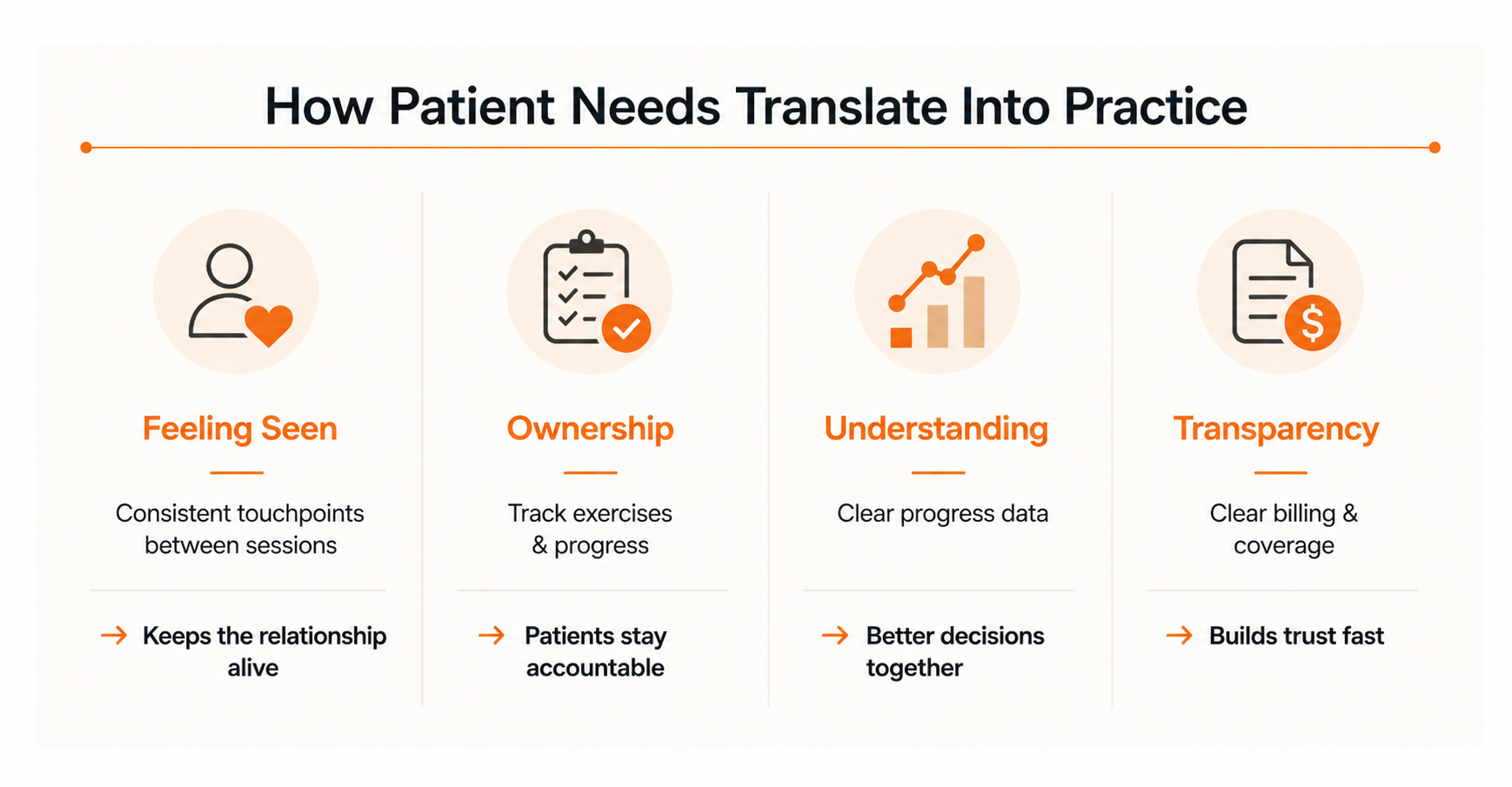
None of this is a coincidence. It’s the result of building a platform around what patients and providers actually need.
What patients want isn’t a mystery. They want to feel cared for. They want a voice in their treatment. They want to take ownership of their health between appointments. And they want to understand what they’re paying for.
These expectations are fundamental to what good care looks like, especially as healthcare continues its shift toward value-based models. The clinics that figure out how to deliver on these priorities at scale will be the ones that earn patient loyalty and drive better clinical outcomes. PhyxUp Health is built to help you do exactly that.